Showing posts with label jam. Show all posts

Wednesday, 27 October 2010

Zombie Brain Cupcakes (Easy Halloween Cupcake #2)


Zombies. Rotten reanimated corpses stumbling hither and thither in search of brains and other various human body parts on which to feed. I love them for it. Zombie movies, zombie games, zombie merchandise, I devour them all with a ravenous hunger that rivals any denizen of the undead. Unlike the other usual suspects of Halloween, such as vampires, witches and mummies, who can simultaneously be bad while exuding both sex appeal and style (don’t think a mummy can be sexy? Then you haven’t seen Arnold Vosloo), zombies seem to exist for no other reason than to kill. They are remorseless, they are ruthlessly terrifying, they are…not at all appetizing. And, at least for those zombies of George A. Romero’s fertile imagination, they are actually quite gross. I don’t want to see that on a cupcake, although there are some who might. But, there are ways to create a zombie-themed confection without resorting to decomposition.


One easy way is to use something like zombie hand picks, which can easily be put on an Oreo crumb-covered cupcake to simulate a zombie rising from the dead. The way described in this post is to make “brain” cupcakes, which would also feel right at home at any mad scientist gathering.

But first, a scientific interlude about zombies and their quest for

Skip to below if you just want to get to the cupcakes!

We’ve all seen zombie movies. We all know the vague anecdotal references to zombie-like trances that voodoo-ish practices can supposedly cause. The question is, can they exist? And the answer is…what do you mean by zombie? There are two main classes of zombies, as I see it. Those that are truly dead, and those that are mindless.
Radiation. Apocalypse. Mystery virus. Or, as is the case with many zombie movies: cause unknown. The catalyst in any classical zombie outbreak is some precipitating factor that inexplicably reanimates dead tissue. The dead rise and inevitably being to hunt humans.  Can it happen?

Negative. When I say dead, I mean really dead, not just clinically dead. In the laboratory, scientists have been able to revive dogs who had been clinically dead for up to 3 hours. But I’m not talking about someone whose heart stopped and was revived. I’m talking someone who is truly no more…has ceased to be…is expired and gone to meet his maker…is a stiff...bereft of life…metabolic processes are now history…kicked the bucket…shuffled off his mortal coil…run down the curtain and joined the bleedin' choir invisible…an ex-parrot, er, I mean ex-person. Yeah. That won’t happen. Without getting too scientific, muscles need energy to move, in the form of ATP. ATP production requires functional metabolism on a cellular level. Muscles also require input from the brain for coordinated movement. Reflex movement, no. But the type of coordinated movement that is necessary for walking (much less hunting) would be impossible for a dead brain. Nevermind that in order to hunt, zombies would have to retain some level of higher cortical function. Yes, in the confines of a fantasy movieverse, one could make a tenuous rationale for undead zombie metabolism and movement that can hold up well enough for two hours, especially if people want to believe, but as far as having to worry about undead hordes, it won’t be a problem. Although, if you are interested, a Harvard psychiatrist named Dr. Steven C. Schlozman has written an interesting mock journal article examining the zombie brain.

However, another important tenant of undead zombie lore (and the zombie mythos in general) is: if you get bit (and aren’t completely devoured on the spot by zombies) you’ll become a zombie yourself. For Romero zombies of the undead variety, it isn’t always clear whether the transformation occurs because the person died and death itself is the only requirement for becoming a zombie, or because there was some sort of contaminant in the blood, either a toxin or a virus. Which segues into the second form of zombie: living people who act like zombies.
Whether by voodoo, toxin, or pandemic illness, some zombie outbreaks are caused by living people who only act like the undead, without higher brain functions. Such scenarios encompass the Haitian “zombies” as well as the “zombies” from stories such as 28 Days Later and I Am Legend. Is it possible?...Maybe…

Voodoo Zombies
According to West African and Haitian traditions, zombies (or zombi) are dead people that can be revived by a sort of shaman called a bokor. In Haiti, zombie creation is accepted as a reality, so much so that there are laws enacted by the Haitian government outlawing it. In the 1980s, the work of a Harvard ethnobotanist (someone who studies how different cultures use plants), Dr. Wade Davis, brought Haitian zombies to worldwide attention when he published books claiming that he found evidence that bokors induced a zombie-like mindless trance through the use of chemical agents, namely tetrodoxin that had been isolated from pufferfish. Dr. Davis’ hypothesis was that the combination of tetrodoxin and dissociative drugs first induced a state of animated suspension which the person believed was death, followed by re-awakening post-burial inducing a psychotic state (perpetuated by continual medication from the bokor) that convinced the person he was a zombie, and making him susceptible to control. As evidence, Davis highlighted the now-famous case of Clairvius Narcisse, who claimed that he had “died” in 1962 and was revived by a bokor and forced to work on a sugar plantation for 18 years as a slave. However, there are some gaping scientific holes in Dr. Davis’ theories, starting with the fact that tetrodoxin can cause paralysis and unconsciousness, but not the trances that Davis describes, and certainly not for years. Many in the scientific community also doubt that any person, bokor or not, would be able to keep someone in a constant hallucinogenic trance for years.

Far more likely, the reported zombie cases in Haiti are a combination of people being accidentally buried alive and suffering several psychological trauma as a result, or of mistaken identity due to a combination of a wandering mentally ill person identified by mourning relatives. A case study published in Lancet examining “zombie” cases in Haiti (Lancet 1997; 350:1094-1096) used DNA testing to determine that most “zombie” cases were actually cases of mistaken identity by a bereaved family. In only one case was the “zombie” found to actually belong to the family that claimed her, with a quick examination of her tomb revealing that it was empty. She was diagnosed as having suffered anoxic brain injury from being sealed in the tomb, which accounted for her zombie-like trance – oxygen deprivation destroyed her higher brain functions. That particular case is a tad sinister since it was clear that 1. She was buried; and 2. Someone probably removed her from her tomb, because her tomb was filled with rocks. The scientists who investigated left the door open to the possibility that some person (call him a bokor or whatever) might very well have poisoned her to simulate death, and then retrieved the body later. The possibility for that to happen to other people does, in fact, exist.

Zombie Infection
So what about a plague upon mankind that reduces its victims to mindless and/or crazed hordes, a la 28 Days Later? These “zombies” are definitely alive, but no longer in control of their faculties. Could humans become exposed to or infected with some disease that alters their brain chemistry to such an extent that they can exhibit zombie-like behavior? It might be unlikely, but it isn’t technically impossible.

When neurotransmitters become aberrantly regulated, they can have a severe impact on behaviors such as aggression. Pump rats full of serotonin, and they attack each other more easily than they would otherwise. Throw them enough out of whack in response to a disease, for a large enough segment of the population, and theoretically it is anyone’s guess what will happen.

As far as viruses go, there is already at least one virus out there that mucks up brain chemistry, causes hyper-aggression, and is transmitted through a bite: rabies, which proves that aggression-causing viruses do exist in nature. Given the rate of expected new virus discovery in the coming decades (Proceedings of the Royal Society B: Biological Sciences, 275 (1647), 2111-2115), plus, the constantly expanding pool of zoonotic viruses (viruses that are coming from animal hosts to infect humans), who knows what challenges new viruses might bring. Don’t misunderstand, I’m not saying it will happen, I’m just not saying it can’t.

There are other infections that can cause gross behavioral changes. Take Ophiocordyceps unilateralis, which is a fungus that infects ants, turning them into so-called “zombie ants”.  Basically,  this fungus can only thrive under certain exact conditions, and when it infects an ant, it hijacks the ant’s behavior to the point where the ant seeks out leaves in those exact specific locations where the fungus can grow, and when it finds them, it clamps down on the leaf and dies. Once that happens, the fungus spores in the ant’s body sprout and disperse seeds. If the ants are moved to even slightly different locations after death, no spores sprout, so this induced behavior is extremely specific and solely designed to provide the fungus with the correct environment. Or how about Toxoplasma gondii, for instance. This parasite lives the majority of its life cycle in the gut of cats, which is where it wants to be most of the time. But when it sheds its eggs, those eggs are eaten by other critters such as rats, where they hatch. But the brand-new T. gondii wants to get back to cats pronto, so it alters the behavior of infected rats in one vital way: Normally, rats have a panic attack when they come into contact with cat urine, which is an evolved response to keep them out of areas where cats live and patrol. Buuuut...infected rats lose this anxiety when they smell cats, so they just waltz into cat-infested areas, presumably to get eaten. Humans can also be hosts to T. gondii, and there is some (controversial) evidence that this parasite can also alter behavior in humans. There might even be a link between T. gondii infection and schizophrenia, although this is not completely understood, and is a matter of much debate. But the point is, there are parasites out there that can hijack behavior in a variety of different ways, even when those ways go against every tenet of self-preservation. Just because it hasn’t verifiably happened yet for humans doesn’t mean that it never will.

Now, are these living zombies true zombies according to genre purists? If you have hordes of crazed people hunting down humans and chomping on them, do those distinctions even matter?

Whew! That was a long interlude! Sorry, I’m a biologist, and this stuff excites me. But now on to the

These cupcakes are pretty easy, they are more decoration than anything else. I injected heated jam into them to make them look “bloody” (check out my Vampire cupcakes to see more details on the actual injection). But, you can fill them with anything you want, or nothing at all. Some cherry pie filling from a can would work well mixed with some almond extract, or some red Jell-o to make a poke cake. If you are using cherry pie filling, or any filling that involves cutting a plug out of the cupcake for filling, you can use any type of batter you want. If you are relying on something soaking into the cake itself, like jam or Jell-o, I recommend a yellow or white batter so it is easier to see.

So, step one, bake those cupcakes!

Step two, fill them or poke them, or whatever you are planning to do. Like the vampire cupcakes, I used a syringe to fill these. And like I mentioned in my previous post, if you remove the needle part too fast, the jam will come gushing back out of the hole, so easy does it. Although, these can look a little messy. They are brains, after all.

Then, make some icing, and dye it a light grey color or a light beige color with some gel. I used a basic buttercream (recipe below) but you can use any icing that will stand up to being piped, and that you can dye grey.

You are going to be piping either with a round tip (#12) or with a bag with a ½” snip taken out of the corner. Mentally divide your cupcake surface into halves. Then, in one sequential motion, draw a line down the center of the cupcake, and bring it back up around the edge, tracing a semicircle. Without interrupting the flow of icing, fill down the empty semicircle with a curving zig-zag motion (see diagram below).


This is one hemisphere, so repeat the mirror image for the other half of the cupcake, and voila, brain!


To make it a little more gory, you can dab your bloody filling along the brains. I have a feeling this would work better with the Jell-o than with the jam. As thin as the jam was, it was still a little too thick to run down the sides of the icing in the way I was hoping for. But it didn’t turn out too badly, although it was so hot in my apartment that my icing started to melt.


These cupcakes only take a little extra effort, but they are a great way to pull together a theme. If you have more time, they could be done a heck of a lot nicer than I did, but they get the job done either way. They definitely qualify as on e of the easier Halloween treats!


Basic Vanilla Buttercream

Ingredients

  • 1 cup unsalted butter, softened
  • 3 1/2 cups confectioners' sugar
  • 1-3 teaspoon milk
  • 1 teaspoon vanilla extract
  • 1/8 teaspoon salt

Directions
1. Beat softened butter until fluffy, then add in the sugar and salt.
2. Add in vanilla extract, and milk one tsp at a time until you reach desired piping consistency

Vampire and Slayer Cupcakes (Easy Halloween Cupcake #1)


Like my previous Halloween post on Quick Creepy Treats, this post and the few following it are not actual recipes, but ideas and directions for assembly of some quick Halloween-themed treats, in this case, cupcakes. But not just any cupcakes…vampire cupcakes…and slayer cupcakes!

In other words, 

Welcome to the Hellmouth. Or my kitchen. Either way. Now, vampirism is a cumbersome and complex topic, full of history and pop culture references. For just a bite (get it?) of vampire lore concerning that most famous of all vamps, keep reading, or scroll down to the pics to get back to the Buffy baking!


Vampires, those eternal creatures of the night that feed on the life forces of the living, make an appearance in the legends of nearly all of the world’s cultures, from the Lilitu of ancient Persia and the Lamia of ancient Greece, all the way to the Loogaroo of the Caribbean (as well as several varieties not brought to you by the letter “L”). Stories of the undead who drain the life essence of humans exist on every continent, but perhaps nowhere so famously as in Eastern Europe, the home of the infamous Dracula.


Even before Bram Stoker came along, vampire mythology had a long tradition in eastern Europe, most notably amongst the Slavs and Romanians. Although he was not the original source of the vampire legends, one man’s legacy provided the basis for our modern classical concept of vampires as described by Stoker: Vlad the Impaler.

Vlad the Impaler, aka Vlad Tepes, was born in Transylvania, but he did not technically reign there. Vlad III was actually the Voivode of Wallachia, a principality that is part of modern day Romania. Voivode is a uniquely Slavic title that combines the authority of a prince with that of a supreme military commander. Vlad inherited the voivodeship from his father, Vlad Dracul, so named because he was a member of the Order of the Dragon (from the Greek: Δράκων (Dracon)). Because of this, Vlad III became known as Vlad Dracula, literally “son of the dragon”.  But there was something prophetic about this moniker, because the Romanian word drac has a meaning of its own: devil.

Now, Vlad did not start out as a torturer and mass murderer. He started out as an eleven year old boy who had been sent as a political hostage to the Ottomans as a show of loyalty between Vlad’s father and his tenuous Turkish allies against the Hungarians. Such things were common during this time period, but Vlad was badly mistreated by the Ottomans over a period spanning 5 years, which sowed the seeds of his implacable hatred of the Ottomans later in life. At the age of 16, Vlad’s father was murdered by the boyars (aristocrats) of Wallachia, who had allied with the Hungarians, while his older brother Mircea was blinded and buried alive. So there was quite a bit of revenge mixed into Vlad’s bloody story. Everything came to a head on Easter Sunday, 1457, when Vlad finally had his revenge: the older boyars and families were all impaled, while the younger boyars were enslaved to rebuild Poienari Castle. None survived. Over the rest of his reign, Vlad systematically wiped out the entire aristocracy of his country, who were not only associated with the murder of his family, but who also had a long history of undermining the Voivode’s authority.

Vlad III’s reign itself was not so very remarkable in the context of a 15th century ruler who was trying to consolidate power – he killed everyone opposed to him or who he thought might pose a challenge to his authority in the future, including both his own people and those of rival nations.  But what made Vlad so interesting, and what undoubtedly caught Stoker’s attention, was his unusual method of killing and torturing. As he did with the boyars, Vlad preferred impalement as his execution method of choice, with a side of torture thrown in: the stake was gradually driven into the bodies – so gradually that it could take days for the victim to die. And Vlad didn’t stop with the boyars, he impaled tens of thousands of people, many of whom were prisoners of war.  In 1462, Mehmed II, ruler of Constantinople, was said to have retreated back to Ottoman lands with his army in fear and disgust when he encountered more than 20,000 Turkish prisoners of war staked to the ground outside of Vlad’s capital city.  And while tales of his cruelty and massacres are still infamous in adjacent areas and found their way into many local vampire legends, in Romania he is still lauded as a national hero for his war against the Ottomans.

However, the real-life Dracula didn’t lend much to Stoker beyond his name, location, and method of execution: a stake through the heart. Which brings us to:

The contributions to pop culture of Joss Whedon notwithstanding, the most prevalent vampire hunter lore again comes from Eastern Europe, especially from Romani oral traditions (not to be confused with Romanians, Romani are Gypsies). According to Romani legends, the offspring of a vampire and a mortal, dhampir, had the ability to see and identify vampires, and could thus protect their villages from them. They also had the extra advantages of superhuman speed, strength and agility, making them well equipped to throw down with vampires.  There are rough counterparts to this concept in several Balkan and Slavic areas, some half vampires and some not, but all endowed with extra abilities to combat the supernatural. However, unlike modern fictional portrayals of vampire hunters, the hunters of legend were usually identifiable by the fact that they were grossly malformed.

And now, back to our regularly scheduled baking!

 These cupcakes are so simple, I really think I gave them their own post in order to have an opportunity to write about vampires and somehow incorporate Buffy into my baking. But in any event, as with the previous Halloween treats I posted, this is the simplest version of a theme. Depending on the amount of time you want to spend, you can get proportionally more elaborate than I did here.

This is what I used.
First, you bake some cupcakes. Easy, right? I used a Sprinkles vanilla cylinder because I had it on hand, but you can make any kind you want. But, give some forethought to how you want to fill these cupcakes and the method you are going to use to fill them. If, say, you are going to cut a plug out of the cupcakes and fill them with some red colored cream filling, or some cherry pie filling mixed with almond extract, then the cupcakes can be whatever flavor/color you want. If you are going to be like me, and poke some red stuff (ie warmed jam or Jell-o to make a poke cake) all over the cake, chose a light batter so that people can see the red soaked into the cake.

Next, you fill the cupcakes. Now, you don’t have to fill them, but it really looks nice to have some red stuff in there for when people bite down. Like I said, you can make your own cream (recipe at end) and dye it appropriate colors, or you can use some chopped cherry pie filling from a can mixed with some almond extract. If you do either of these methods, cut a plug out from your cupcakes and fill them.
Heat until the jam is thin.

Now, rather than this, I took an easier route with these. I decided to try poke cupcakes, which usually means that you poke the cupcakes with a toothpick and pour something thinned out over them to be soaked down into the cake. The most common thing to pour over is Jell-o, either strawberry or cherry. But I went one step easier, and used raspberry jam heated (carefully!) in the microwave. If you do this, be sure to buy jam and not preserves, because preserves don't melt in the same way.  It was fast, easy, and made the vanilla cupcake taste rather like a thumbprint cookie. But, instead of just poking, I actually used a syringe to inject the cupcakes with the jam, since it was still a little thicker than Jell-o (the same syringe as in my Mini Tortuga Rum Cakes, if you want to see detailed syringe pictures).  
I'm not trying to be spooky with this pic, I didn't realize the flash was on...
Don't mind my messy table...
The syringe sort of looks like an overgrown reverse mosquito, forcing blood in rather than sucking it out. And I learned something very important. When you do this, with jam at least, withdraw the syringe tip slowly, otherwise the jam will come gushing back out of the hole like this:


This isn't tragic, they are Halloween cupcakes after all. If this happens, just be a little more careful when you frost, because you want the icing surface to be as white as possible. You'll notice that I poked anywhere from 1-3 holes per cupcake. I think 2 holes worked out ideal. If you are going to use Jell-o, you can still use the syringe, but it will have an easier time soaking into the cake than the jam, so you can just poke with a toothpick and let the liquid soak in.

Now you can frost. You don’t need to do much with the frosting itself, so you can use white icing from a tub if you wish, or a basic buttercream, or you can slap on a Swiss meringue buttercream or 7 minute frosting…really whatever you feel like, as long as it is white. When you choose your frosting, go ahead and frost your cupcakes smoothly, not in a terribly thick layer.

Now, you poke holes in the frosting and add “blood” and this is really where it helps to have a red filling that can double as blood on the top of the cupcake. Make 2 holes in the frosting that look like a vampire’s bite mark, and fill them with your “blood”, dribbling blood away from the holes. Voila! Easy vampire cupcakes. I rushed them a little bit, so they aren't as pretty as I would have liked, but you get the general idea...

My apartment was unseasonably hot, and my icing started to melt!

And then when you cut it open, there is a nice amount of bloodiness in the cake:

In this particular cupcake, I managed to line up the bite puncture wounds perfectly with the jam in the cake. It looks cool, but it wasn't intentional, and isn't necessary. The only way anyone would notice is if they split the cupcake down the middle anyway.

To complete the theme, because I was determined to tie it in somehow, I made some “slayer” cupcakes, settling on a "stake through the heart" theme: assemble them the same way as the vampire cupcakes up through the frosting part. After the layer of white frosting is down, take some of your frosting and dye it red. Then, pipe a heart onto the top of the cupcake, and put a stake through it (in this case, a pretzel stick). 


If you think the cupcake is a little ambiguous, you can always write “Stake the <3” on them instead of just the heart, like I did. And if you want, you can ground up some Oreo “ashes” for decoration around the edges, because you, my friend, have just dusted a vamp.

Is this sophisticated decorating? Not at all. Marshmallow fondant would probably make a nicer surface than the icing, but I just didn't have the patience. Ditto for the heart. A chocolate-dipped pretzel rod would have made a better Mr. Pointy. I could have dribbled the jam a bit more artistically. But you don't have to go nuts for a simple theme. After all, everything doesn't need to look like the Cake Boss did it. I don't know about you, but my baking time is always competing with other things. When I made these, I was simultaneously baking and decorating cupcakes, getting dinner together, assembling a Halloween costume, and reading articles for work. But these cupcakes work with my schedule. They are easy, cute, and get the point across. 


This recipe is actually a Twinkie filling copycat recipe that has been floating around the internet for years in many different places.

Ingredients
  • 1-7oz jar marshmallow cream2 tsp hot water
  • 1/4 tsp salt
  • 1/2 C shortening
  • 1/3 C powdered sugar
  • 1 tsp vanilla

Directions
  1. Dissolve the salt in the hot water and allow it to cool down to room temp
  2. Whip all ingredients except the salt water until fluffy
  3. Slowly add the salt water and whip well until fully combined and fluffy
  4. Add dye gel if desired


Tuesday, 30 March 2010

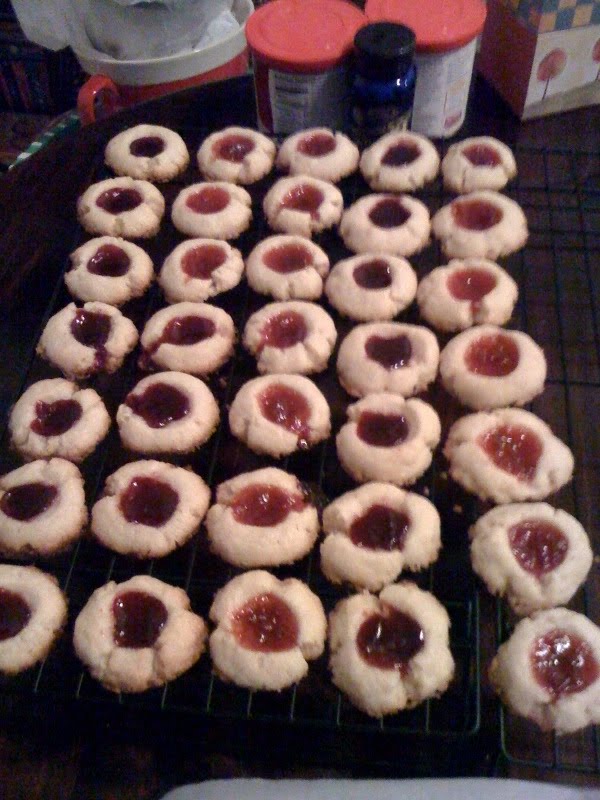
Thumbprint Cookies (Strawberry Rhubarb and Raspberry)

Last month, my cousin Jennifer brought cookies to my house, delightful little thumbprint cookies. They were perfect, with their jeweled colors and melt-in-your-mouth buttery goodness. But do you know what made them extraordinary? My husband loved them. My husband, who is indifferent to almost all baked goods known to man, not only ate them, but pronounced them his favorite cookie of all time.

Well.

That was that, as they say. I've never had any desire to make fruit thumbprints before (I inevitably lean towards cookies filled with chocolate etc), but I immediately requested the recipe from my cousin, so I could take a look at it. A little searching turned up the fact that this recipe originally came from the book Williams-Sonoma Collection: Cookies, under the moniker of "Ruby Jewels."


The recipe itself is very simple to put together, with one brief spell in the refrigerator. The cookie dough is close to a basic shortbread dough, meaning that it has a 1:2:3 ratio of sugar to butter to flour and no leavening agent. Incidentally shortbread gets its name from one of the original meanings of the word "short" -- crumbly. To "shorten" literally used to mean to make something crumbly, which is why we now call any fat that can be used to make a crumbly texture "shortening." Shortcake (as in strawberry, etc) is almost exactly like shortbread, except with a leavening agent, and potentially with vegetable shortening replacing some or all of the butter.

A brief word about jam choices. My cousin made these cookies with Smucker's Seedless Red Raspberry jam. I used the same, but I also wanted to try some different flavors. I really had my heart set on strawberry rhubarb, because I love strawberry rhubarb pie in the summer, but the rhubarb season is so darn short. When I tasted my cousin's cookies for the first time, I thought how perfect it would be to capture that flavor in a cookie that could be enjoyed all year round. There are several recipes out there for homemade strawberry rhubarb jam, but I admit, I was intimidated. Luckily, I found what I was looking for in the mall of all places, at Harry and David's. They carry a strawberry rhubarb conserve which is available all year. It has chunks of fruit in it, but they can be reduced with a few seconds in the food processor if you want (or you can do what I did and just scoop the jam out from between the fruit bits). If you have a store in your local mall, check them out. Besides the strawberry rhubarb, there were a few other jam varieties in there that I had my eye on for future cookie-making, including: bing cherry, marionberry, blackberry, and blueberry. There are also some lovely apple and pumpkin butters that might be good for the autumn, I'll be looking into those in a few months.

I only took one picture, of the finished cookie, but believe me, they are easy. I used a spoon instead of my thumb to make the indentations because I found that this way produces a well with higher walls, and I lose less filling during baking.

The dark filling is raspberry, the lighter one is strawberry rhubarb.

 Ingredients
1 C cold sweet butter, cut into pieces
2/3 C granulated sugar
2 1/4 C AP flour
2 egg yolks
1 tsp vanilla
fruit jam 

Directions
 * This recipe can be made entirely in a food processor, or with a stand mixer and paddle. I used the mixer because I didn't feel like cleaning my food processor. They came out great, so don't worry if you don't have a processor.*
  1. Preheat oven to 350°F
  2. In a small bowl, whisk the egg yolks and vanilla together, set aside.
  3. Combine the flour and granulated sugar in a mixer with the paddle attachment or in a food processor/mixer and process just to blend. For Mixer: Sprinkle the butter onto the flour/sugar mixture and mix on medium until the mixture looks crumbly, this won't take long. Add in the egg mixture and mix until the dough pulls away from the side of the bowl. For Processor: With the machine running, add the butter 2-3 pieces at a time and process until the mixture looks crumbly. With the machine still running, add the egg yolk mixture and process until blended and the dough begins to pull away from the sides of the bowl.
  4. Refrigerate until chilled, about 30 minutes. I leave it in the bowl and cover the top with saran wrap.
  5. Line cookie sheets with parchment paper.
  6. Using a #60 scoop, scoop out dough and roll it into a ball with your hands. Place dough balls on the sheet.
  7. Flour the back of a 1/2 tsp measuring spoon (you will have to keep reapplying the flour), and push the back of the spoon into the cookie until the dough is pushed up even with the rim of the spoon. Be careful not to push all the way through. The cookies will crack a little bit, which isn't tragic as long as the walls of the imprint are intact -- otherwise the filling will run out while baking. If they crack too much, repair as best you can, or re-roll the cookie and try again.
  8. Using a spoon or a pastry bag fitted with a plain tip, fill each indentation with about ¼ teaspoon jam.
  9. Bake the cookies until the edges are golden, 15-20 minutes.
  10. Let the cookies cool completely before transferring the cooled cookies to wire racks.
I had the fleeting thought that a dab of peanut butter underneath the jam would be perfection. My husband insists that this is over the top, but I think I will try it anyway...